Researchers from the Faculty of Medicine (Udelar) and the Pasteur Institute in Montevideo have developed a tool to study a process that occurs in the nervous system of people with amyotrophic lateral sclerosis. The study was published in the renowned scientific journal PNAS. https://doi.org/10.1073/pnas.2536562123
Researchers from the Udelar Faculty of Medicine (FMed) and the Pasteur Institute of Montevideo (IP Montevideo) have developed a new tool to study a process that occurs in the nervous system of people with amyotrophic lateral sclerosis (ALS), a disease that affects the neurons that control the muscles.
The research, conducted jointly by members of the Department of Biochemistry and the Center for Biomedical Research (CEINBIO) at the FMed and IP Montevideo, in collaboration with the Clemente Estable Institute for Biological Research, the Institut Pasteur in Paris, and the University of Alabama at Birmingham, was published on April 24 in the renowned scientific journal PNAS.
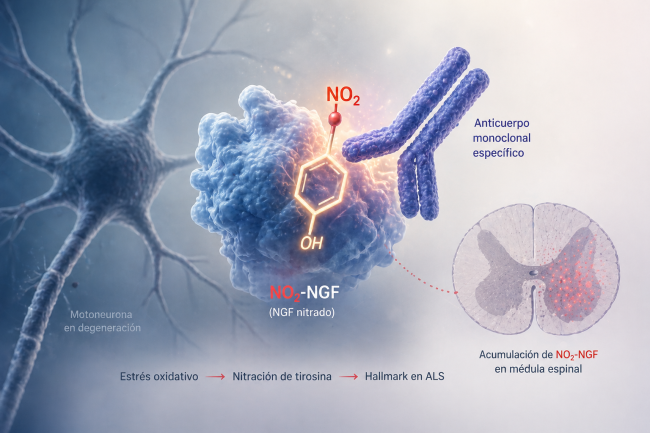
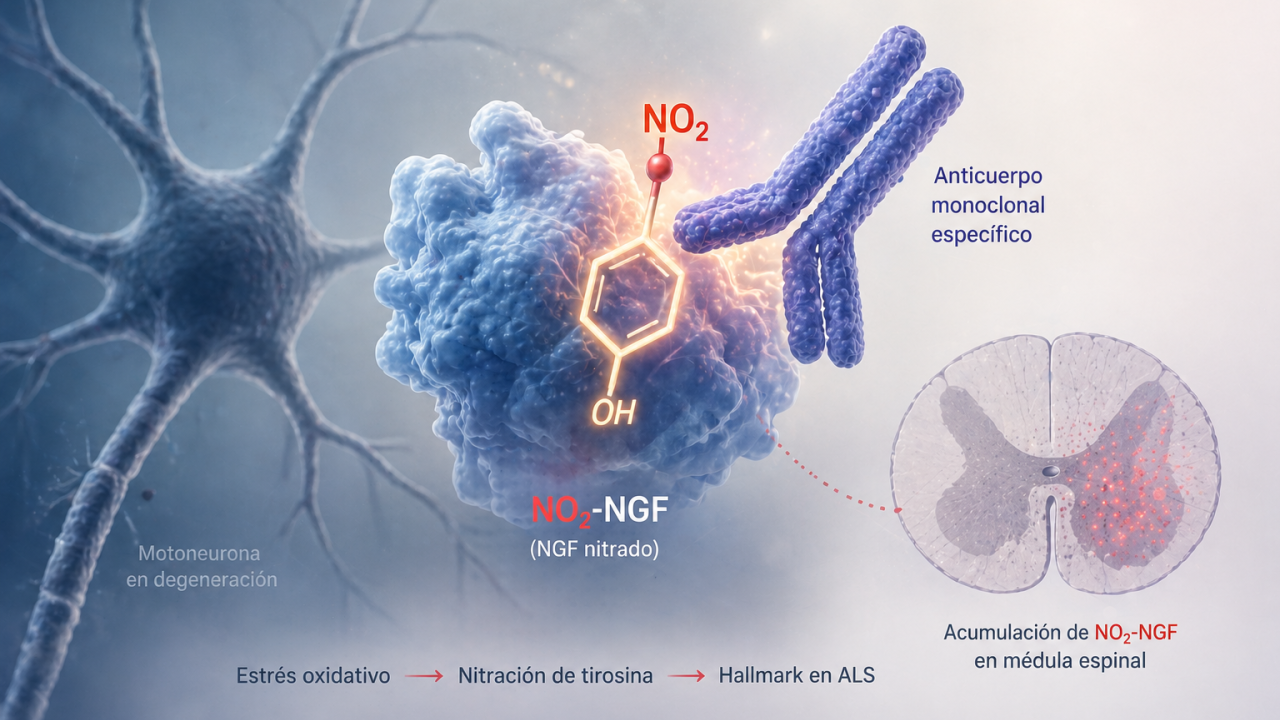
The collaborative study focused on a protein called nerve growth factor (NGF), which is essential for the survival and functioning of neurons. However, its activity can change when nerve cells undergo a chemical modification linked to oxidative stress. This oxidative modification is part of a process that occurs when substances normally produced by cells are formed in excess—for example, due to aging, inflammation, or exposure to certain factors—and begin to damage them.
This change in the NGF protein is a chemical modification known as nitration, which can cause the protein to become harmful to neurons.
To detect this altered form, the team created and characterized a monoclonal antibody—a laboratory-designed molecule that acts as a specific detector for a particular variant of a protein. These types of tools are widely used in diagnostics and biomedical research. In this particular case, the antibody was designed to recognize only nitinated NGF.
Thanks to this development, the scientists were able to identify areas of the nervous system affected by ALS that showed accumulation of the modified protein, both in animal models and in human samples. In addition, they observed that these antibodies can block its toxic effects on nerve cells in the laboratory.
The finding suggests that this oxidative modification could serve as a biomarker for the disease and opens up new lines of research to improve the diagnosis and treatment of patients with ALS.
“This work allowed us to explore a hypothesis using animal models and then confirm it in patient samples; this latest development represents a decisive step toward the greater biomedical impact of the research and its application to a neurodegenerative disease in humans,” explains Rafael Radi, full professor in the Department of Biochemistry and at CEINBIO, one of the study’s authors, who submitted it to the prestigious scientific journal of the U.S. National Academy of Sciences (NAS).
“The development of monoclonal antibodies that specifically recognize the nitration of nerve growth factor is a tool that paves the way not only for a better understanding of the disease but also for exploring the role of nitro-oxidative stress in other neurodegenerative disorders, such as Alzheimer’s,” notes Valentina Varela, a researcher at the Institut Pasteur in Montevideo and one of the study’s authors.
Both researchers highlighted the importance of national and international collaboration and of a network of institutions and individuals whose interdisciplinary approach made this research possible.
To cite the article: V. Varela, S. Garcimartín, E. Trias, A. Zeida, M. Richter, A. de León, E. Miquel, P.H. King, B. Vulliez-Le Normand, M. Martinez, P.M. Alzari, S. Bartesaghi, R. Radi, & L. Barbeito, “Monoclonal antibodies against nitrated nerve growth factor reveal an oxidation-dependent pathogenic hallmark in ALS,” Proc. Natl. Acad. Sci. U.S.A. 123 (17) e2536562123, https://doi.org/10.1073/pnas.2536562123 (2026).